.png)

.png)
Modern engines are marvels of engineering precision. In both automotive and aviation applications, today’s pumps and injectors operate under extreme pressures—often exceeding 2,000 bar in diesel common-rail systems or tolerances in aircraft fuel pumps measured in microns. While fuels are valued for their energy content, one of their lesser-known but equally critical roles is as a lubricant. Without sufficient lubricity, pumps seize, injectors scuff, and mission-critical systems fail.
The ability of a fuel to provide lubrication to the engine components it contacts is usually defined as fuel lubricity. A lubricious fuel (i.e., with high lubricity) primarily protects engine components from wear and failure.
What makes fuel lubricity so important:
The quantification of a fuel's lubricity is achieved by measuring its ability to minimize wear to surfaces in motion under boundary lubrication conditions. The test methodologies developed to evaluate the lubricating effect of fuels can be divided into various categories, depending on how closely they approximate the field conditions. These include:
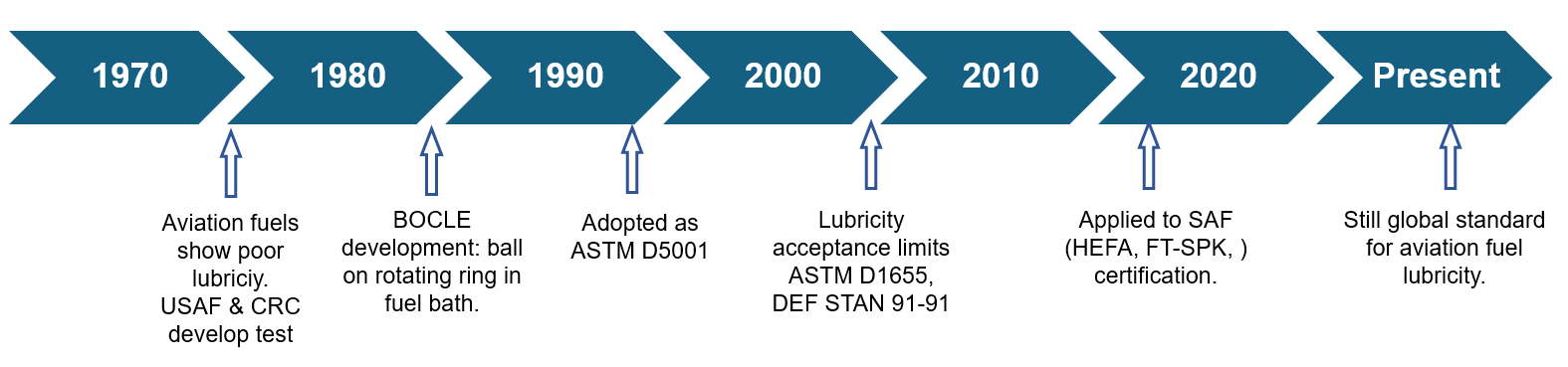
In this last category, the main standardised methodologies used are High Frequency Reciprocating Rig (HFRR) and Ball-On-Cylinder Lubricity Evaluator (BOCLE). In Europe, engineers developed the HFRR to address diesel lubricity. In this design, a steel ball oscillates against a flat steel disk at high frequency under a fixed load, immersed in test fuel. The wear scar diameter (WSD) correlates with the fuel lubricity. In round-robin tests, this method effectively differentiated between high- and low-lubricity fuels and also correlated with distributor pump rig wear. This was later standardized as ISO 12156-1 and ASTM D6079 in the 1990s. The Ball-on-Cylinder Lubricity Evaluator (BOCLE) emerged in the United States (Figure 1) under the efforts of the U.S. Air Force and the Coordinating Research Council (CRC) in the late 1970s and 1980s. In this design, a stationary steel ball is pressed against a rotating steel ring partially immersed in the test fuel. The wear scar diameter (WSD) correlates with the fuel lubricity. CRC round robins and pump rig comparisons showed strong correlation between BOCLE results and aviation fuel pump durability. By the 1990s, BOCLE became standardized as ASTM D5001.
Together, BOCLE and HFRR established the foundation of global lubricity regulation, each serving its respective sector. For diesel fuels, lubricity is defined by the maximum wear scar diameter: globally limited to 460 μm at 60 °C under EN 590 and ISO 12156, while the U.S. (ASTM D975) and Canada allow up to 520 μm at 60 °C. For aviation turbine fuels, the maximum wear scar diameter is set at 850 μm at 25 °C under ASTM D1655 and DEF STAN 91-91 (UK) (Figure 2).

For typical aviation turbine fuels (ATF) without doping and after doping with Nalco 5403 (17 mg/liter as per ASTM D1655), the wear scar values obtained from BOCLE-ADV are 0.77 mm and 0.58 mm respectively (Figure 3). These fuels meet the specifications for civil (< 0.85 mm) and military (< 0.65 mm) aviation applications respectively.

In both test methods, the wear of the counterparts is measured and the lower the dimensions of the wear scars, the better the lubricity of the fuel. This holds true for both diesel and aviation turbine fuels. While both aim to simulate and measure wear between metal surfaces under fuel-lubricated conditions, they differ in design, test method, and parameters (Figure 4, Table 1)
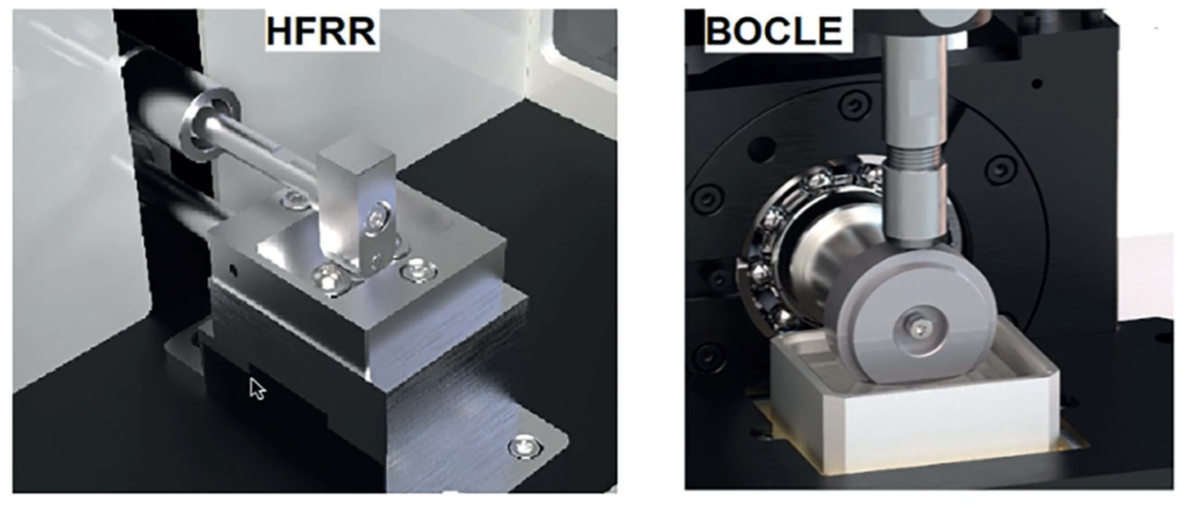

Though the Hertzian contact stresses are similar for both geometries (~ 900 MPa) and both operate in the boundary lubrication regime, there are several key differences between these methods that can affect precision
The precision quantified from repeatability (r) and reproducibility (R) for both HFRR and BOCLE test methods is plotted in Figure 5. One of the key difference is that HFRR has fixed values of r and R across a wide range of wear scar sizes, whereas BOCLE r and R values depend on the wear scar diameter, with larger variability for poor lubricity fuels
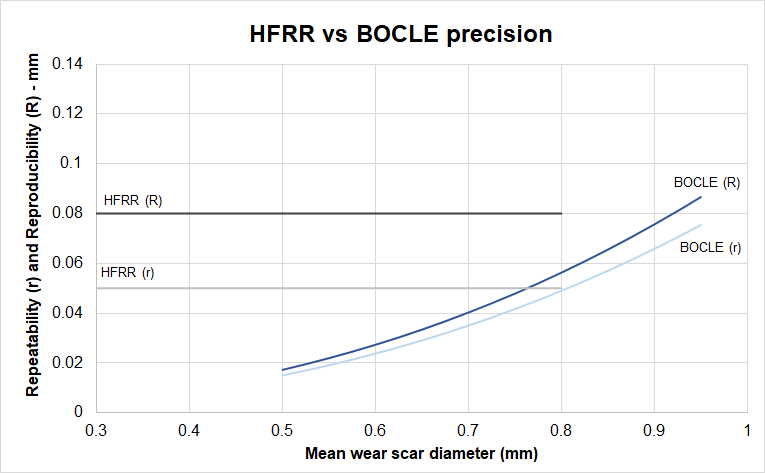
Within the HFRR testing community, there is anecdotal data that points to r and R being dependent on diesel fuel lubricity, nature of wear and type of scar produced. Complicating this further are challenges with defining scar boundaries especially the region of wear that is less well-defined. A better understanding of this will emerge from future round robin programs that include automated edge detection functions for accurate wear scar measurement.
For establishing precision and validating capabilities to differentiate good and poor lubricity fuels, it is crucial to follow the recommended calibration procedure for the BOCLE before each test: read the full article here.
This test method is currently the global standard in diesel fuel testing because of it more closely mimics high speed and high pressure of diesel fuel systems and real-world conditions. The testing of diesel fuel lubricity using HFRR is standardized by the main organizations through several standardized test methodologies:
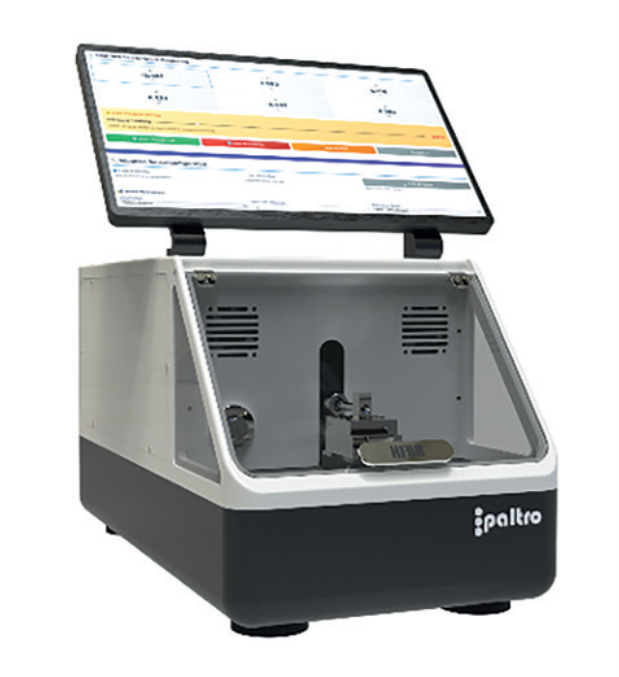
HFRR-ADV is fully compliant with global standards for diesel fuel lubricity testing. With test protocols embedded in the software, you can run tests in accordance with ASTM/ISO protocols. at the click of a button. This means less user training requirements, fewer errors, and lower costs of operations.
The testing of aviation turbine lubricity using BOCLE is standardized by the main organizations through several standardized test methodologies:
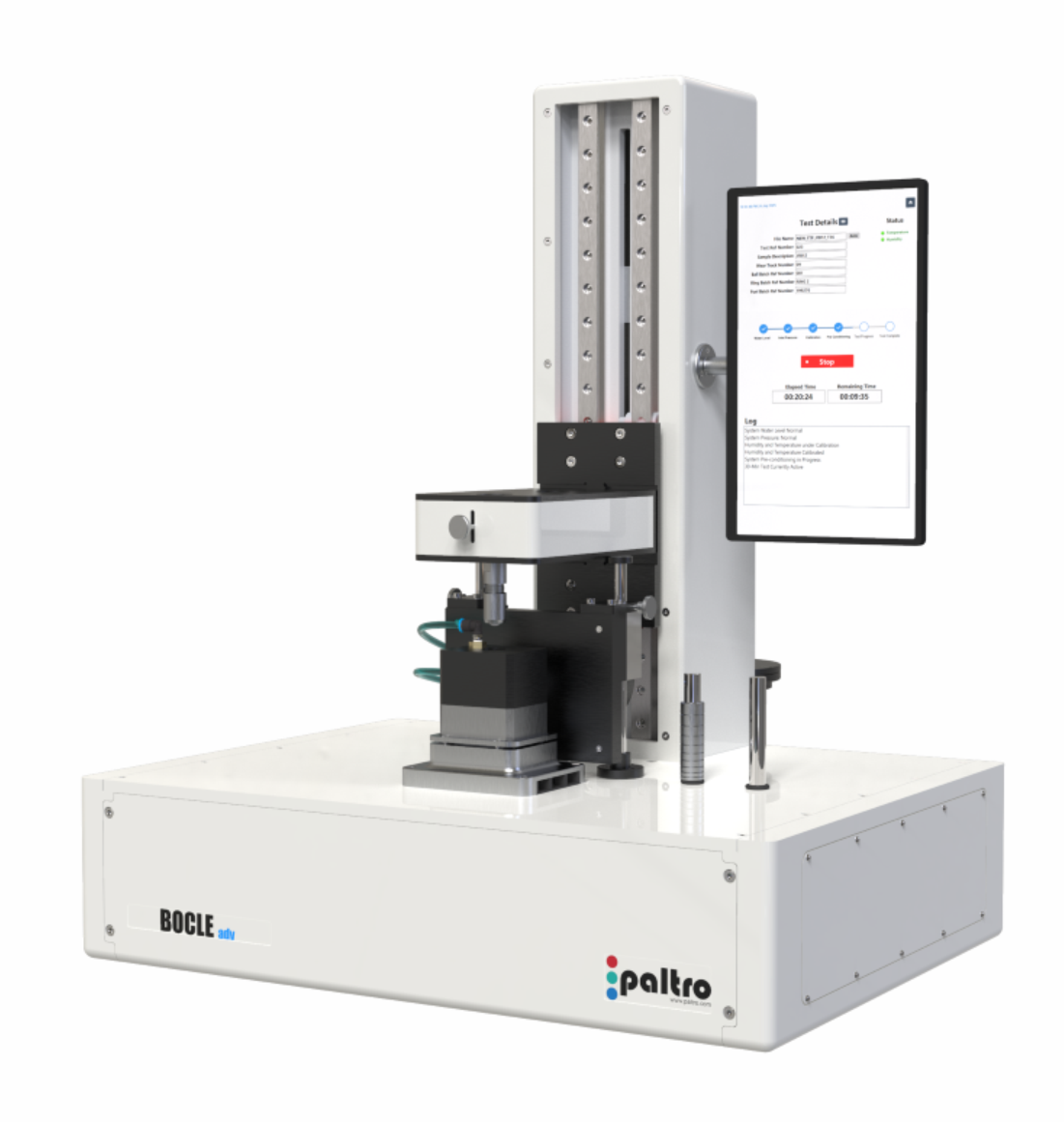
BOCLE-ADV is a next-generation ball-on-cylinder lubricity evaluator for aviation turbine fuels. This innovative unified system revolutionises testing by seamlessly integrating mechanical evaluation, optical imaging, analysis, and reporting. Fully compliant with ASTM D5001, the BOCLE-ADV eliminates the need for a standalone microscope, streamlining workflows, reducing operator effort, and enhancing productivity. Advanced automation, smart sensing, and data logging ensure complete traceability and precision.
Explore BOCLE-ADV compliance with the ASTM D5001 and powerful automation capabilities here.
The lubricity story is not only about conventional fuels. As the world pivots to renewable and synthetic fuels and sustainable aviation fuels, lubricity testing is more critical than ever. New chemistries and novel molecules in synthetic fuels may interact with metal surfaces differently, requiring new calibration data. Interlaboratory variability continues to persist near pass/fail thresholds and ability to differentiate additized fuels. Automation and digitalization will boost the precision of HFRR and BOCLE ensuring that sustainable fuels are safe drop-in replacements.

.svg)
.svg)
