.png)

A recipient of the Distinguished Early Career Award from the US Department of Energy's Office of Nuclear Energy and the Early Career Award from the Society of Tribologists and Lubrication Engineers (STLE), Prof. Sougata Roy brings a uniquely cross-disciplinary perspective to tribological challenges that combines materials, surface engineering and manufacturing.

I am an assistant professor in Mechanical Engineering department at Iowa State University. I direct CoMPASS (Convergent Manufacturing, Processing and Advanced Surface Science) research lab, where my group works on various projects on broad domain of advanced materials and manufacturing, surface engineering and tribology
We are working on various crucial challenges ranging from nuclear energy, bio-lubrication and failures in electrified contacts (i.e. electric vehicles). In particular, we focus into materials tribology aspect where we tune alloy composition and surface characteristics of critical metallic alloys and understand how that impacts on high frequency fretting behavior. Such fundamental understanding can be beneficial for critical components in fission reactors. For bio-lubrication aspect, we reveal the effects of strategic chemical modification and additization to bio-based lubricants on their tribological behavior. From EV tribology perspective, we are working on high entropy alloys which can be coated using laser cladding and present better reliability for electrified contacts.
We take significant time to understand the challenge first and brainstorm potential approaches to resolve or explore it. We leverage a wide range of advanced materials and manufacturing techniques coupled with strategic testing, using the Paltro UniTest 750, and various surface/material characterization techniques to understand the science behind it. Additionally, we have fantastic collaborators with complementary expertise and capabilities at different universities, national laboratories and industries who play critical role in our efforts as well
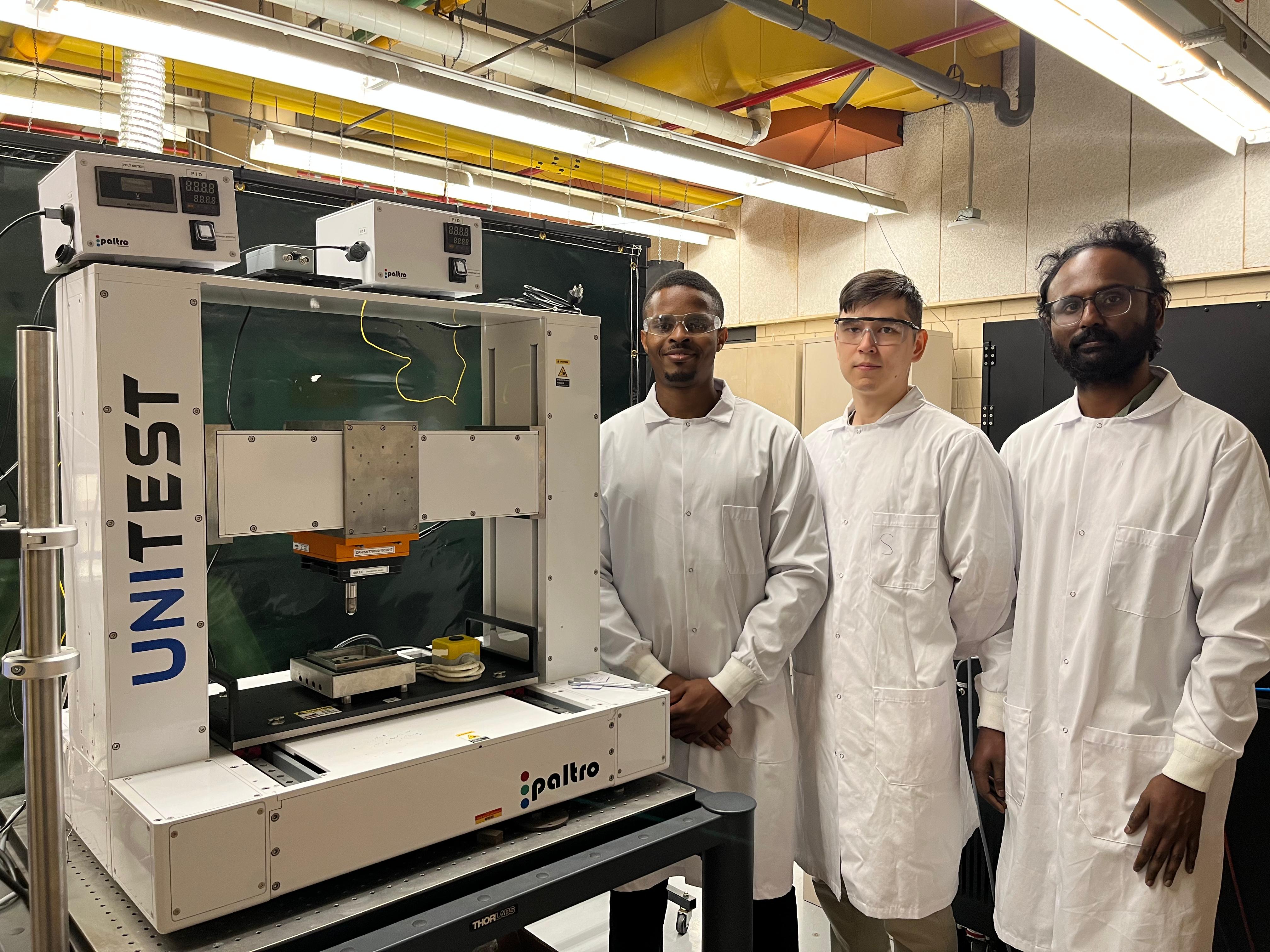
We have several modules in our UniTest-750 which helps us tackle various interdisciplinary research efforts. It is reliable and user friendly, which are important aspects of any experimental system we utilize in research. High frequency fretting module, reciprocating module along with electrified testing and high temperature capabilities are extremely useful for our research.

We are satisfied with UT-750 system so far. Overall, it works consistently and the support system on any challenge experienced till date has been great. We experienced some software related challenges a few times which were resolved without significant delays
1. ‘Analyzing the potential of waste cooking oils as bio-lubricants for electric vehicles’, RSC Adv, 2026, 16,12884-12901, Seshasai N. Ayyadevara, Pial Das, MajherI. Sarker, Brajendra K. Sharma and Sougata Roy
2. ‘Insights into microstructure and fretting wear behavior of additively manufactured oxide reinforced FeCrAl alloy for nuclear reactors’, Tribology International, 2026, 219, 111790, K.R. Ramkumar, Salikh Omarov, Christopher Silligman, Mkpe Kekung, Sanika Paranjape, Pial Das and Sougata Roy

.svg)
.svg)
