.png)

The High Frequency Reciprocating Rig (HFRR) is designed to simulate the boundary lubrication conditions encountered in fuel delivery systems. It operates by generating a controlled reciprocating motion between a steel ball and a flat steel disk, both partially submerged in the test fuel. During testing, a constant load is applied, and the temperature and humidity are carefully controlled. After a defined test duration, the wear scar formed on the steel ball is measured microscopically to assess the lubricating performance of the fuel.

Two standardized test methods are commonly associated with the HFRR, ASTM D6079 and ISO 12156, which define the procedure and conditions for consistent, repeatable measurements. Though the test parameters are same for both methods, there is a significant difference in the environmental conditions of relative humidity and laboratory air temperature. (Table 1). The ISO 12156 has a tighter control over the %RH and laboratory air temperature compared to the ASRM D6079 standard.
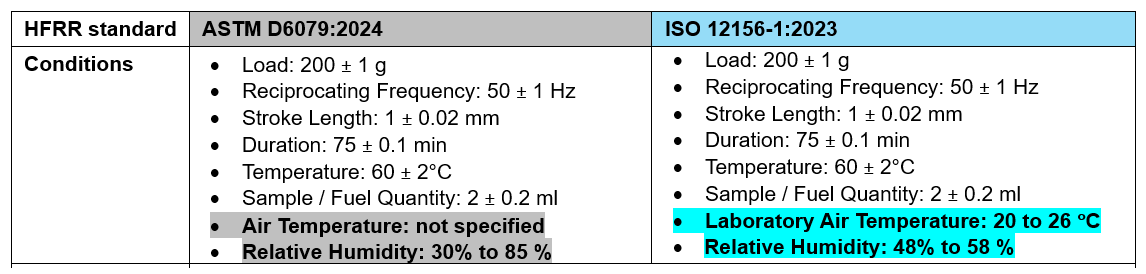
HFRR-ADV offers fully automated humidity control module to maintain the relative humidity at 53 %RH complying with both ASTM and ISO methods.
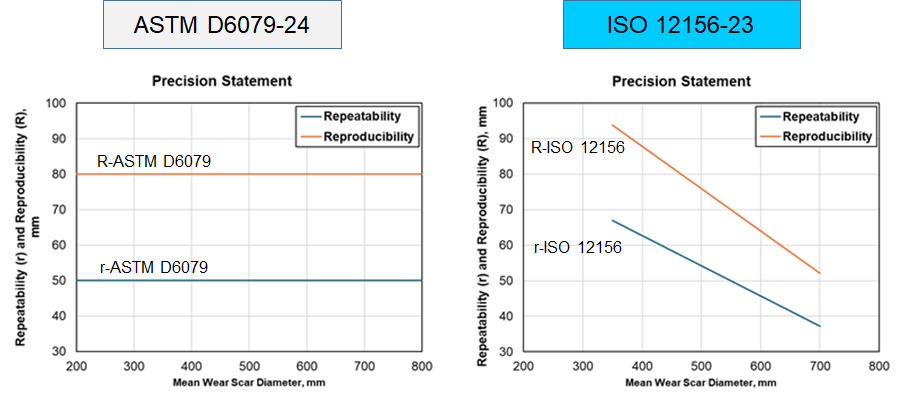
ASTM D6079 and ISO 12156 have different precision statements. The ASTM method has a constant repeatability and reproducibility over the entire range of wear scar from 300 to 700 microns. On the other hand, the ISO standard has repeatability and reproducibility that depend on fuel lubricity. High lubricity fuels have poor precision, possibly related to the nature of wear and the clarity of scar boundaries compared to low lubricity fuels that have good precision (Table 2)

.svg)
.svg)
